

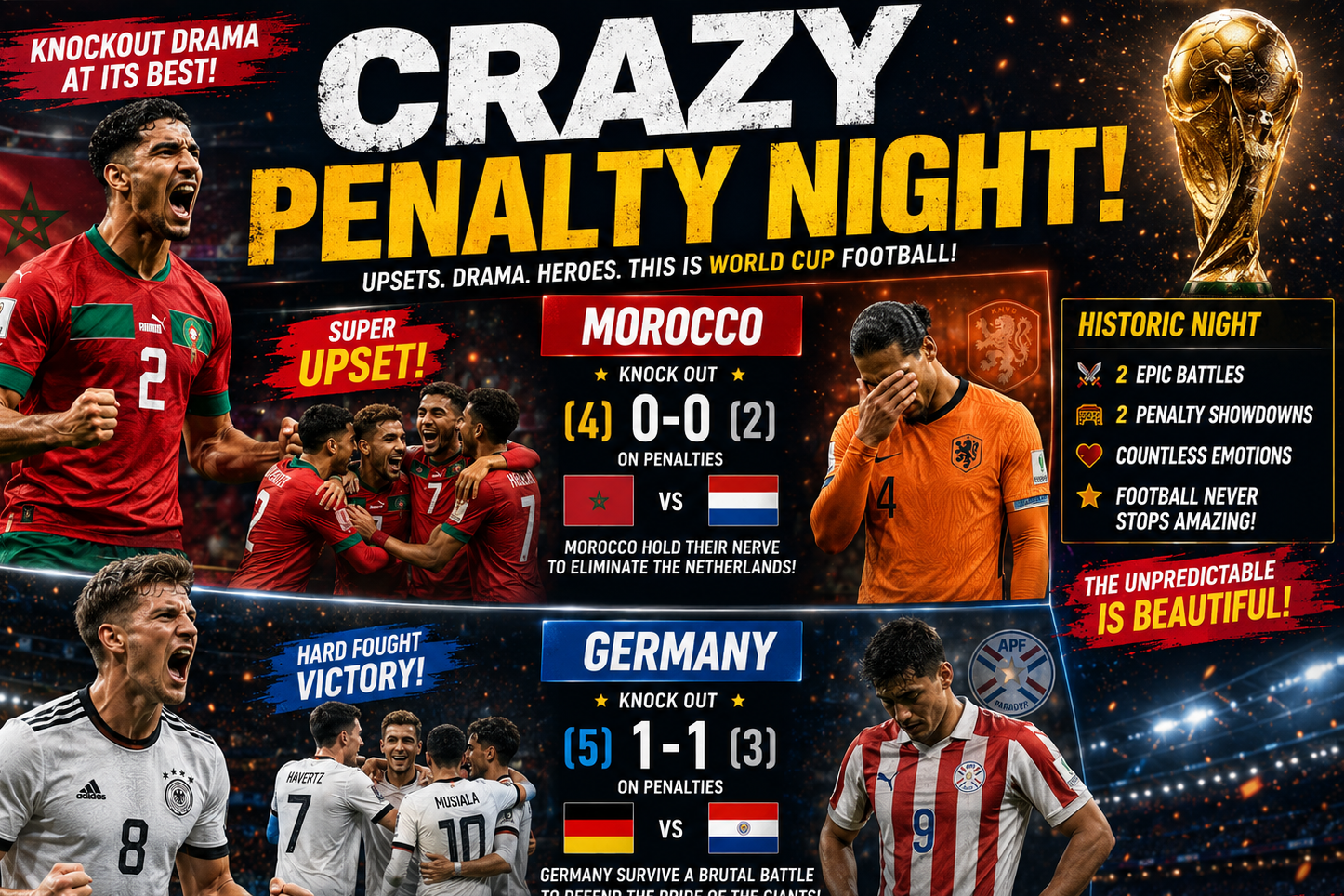
Morocco Shock Netherlands in Penalty Thriller, Germany Survive Paraguay
The knockout stage delivers unforgettable drama, historic upsets, and elite resilience under the highest pressure.
The World Cup Round of 16 produced one of the tournament's most unforgettable nights. Morocco eliminated the Netherlands in a dramatic penalty shootout, creating arguably the biggest upset of the knockout stage, while Germany survived an exhausting battle against Paraguay to continue their pursuit of another world title.
For readers searching for Morocco vs Netherlands penalty shootout analysis, Germany vs Paraguay tactical review, World Cup biggest upset, penalty psychology in football, and World Cup Round of 16 recap, this article provides tactical breakdowns, psychological analysis, and knockout-stage implications without simply repeating the match report.
Why This Became the Biggest Night of the Knockout Stage
Every World Cup eventually produces one evening that changes the narrative of the entire tournament. This was that night.
Supporters witnessed two completely different stories unfolding simultaneously. Morocco achieved one of the greatest victories in its football history by eliminating the Netherlands after a nerve-shredding penalty shootout, while Germany demonstrated why tournament experience continues to separate elite national teams from everyone else.
One match celebrated fearless belief. The other rewarded championship composure. Together they perfectly illustrated why knockout football remains the most unpredictable competition in world sport.
Two Matches, Two Completely Different Stories
Morocco entered the match knowing very few neutral observers expected them to eliminate one of Europe's strongest football nations. Instead of allowing pressure to dictate their approach, they embraced disciplined defending, rapid transitions, and emotional resilience.
Germany faced an entirely different challenge. Unlike Morocco, Germany carried enormous expectations. Every knockout match becomes a test of history, tradition, and experience. Paraguay refused to play the role of underdog, transforming the contest into one of the most physically demanding battles of the Round of 16.
Morocco vs Netherlands Tactical Analysis
Long before the penalty shootout began, Morocco had already succeeded tactically. Rather than attempting to dominate possession against technically gifted Dutch midfielders, Morocco built an extremely compact defensive block that denied central passing lanes while encouraging the Netherlands to attack from wide areas.
This defensive structure forced the Dutch attack into predictable crossing situations instead of allowing combination play through the middle. Every recovered ball immediately triggered fast counterattacks, allowing Morocco to stretch the Netherlands whenever possession changed hands.
Compact Shape Made the Difference
The distance between Morocco's defensive and midfield lines remained consistently short throughout the match. This prevented Dutch creators from finding space between the lines while simultaneously protecting the central defenders from isolation. Whenever the Netherlands attempted to overload one flank, Morocco shifted collectively rather than individually. That defensive synchronization became one of the defining tactical stories of the evening.
Transition Football Over Possession Football
Morocco never attempted to win the possession statistics. Instead, they concentrated on maximizing every transition. The first forward pass after winning possession was almost always progressive, allowing pace to replace prolonged ball circulation. Although the Netherlands controlled larger phases of possession, Morocco consistently produced the more dangerous transition opportunities.
Why the Netherlands Struggled
The Dutch attack generated territorial dominance but lacked consistent penetration. Much of their possession occurred outside Morocco's defensive block rather than inside dangerous central spaces. Without quick vertical combinations, the Netherlands gradually became more predictable, allowing Morocco's defensive organization to grow even stronger as the match progressed.
As extra time arrived, physical fatigue increased while emotional pressure became the dominant factor. The longer the match remained level, the greater Morocco's confidence became.
The Penalty Shootout Was Won Before the First Kick
Penalty shootouts are often described as lotteries, yet elite football repeatedly demonstrates that preparation, confidence, emotional control, and goalkeeper psychology influence the outcome far more than luck alone. Morocco entered the shootout looking calm, connected, and fully committed to every decision. Each player walked toward the penalty spot with visible confidence, while teammates immediately surrounded every successful kick with positive encouragement.
Meanwhile, the emotional pressure shifted dramatically toward the Netherlands. As favorites, every missed opportunity carried greater psychological weight. That invisible pressure slowly became one of Morocco's biggest advantages before a single penalty had even been taken.
Psychology Became the Decisive Weapon
Goalkeepers study body language. Penalty takers manage breathing. Coaches prepare routines. Elite teams rehearse scenarios repeatedly because the smallest emotional detail often determines whether a nation advances or goes home. On this unforgettable night, Morocco executed every psychological detail with remarkable maturity.
Germany vs Paraguay: Why Experience Still Wins in Knockout Football
If Morocco's victory represented the beauty of an underdog story, Germany's triumph over Paraguay demonstrated why tournament experience remains one of football's most valuable assets. Unlike matches decided by overwhelming attacking dominance, this encounter became a relentless tactical battle where patience, discipline, and mental resilience outweighed technical brilliance.
For supporters searching for Germany vs Paraguay tactical analysis, World Cup knockout strategy, Germany tournament mentality, and how Germany wins close matches, this game offered a textbook example of elite tournament football.
Paraguay Refused to Be Overwhelmed
Paraguay entered the match with absolute tactical clarity. Rather than attempting to compete in an open attacking contest, they compressed the central midfield, reduced passing lanes, and forced Germany toward wide areas where crosses became more predictable.
The South American side accepted that Germany would enjoy more possession but remained determined to prevent dangerous combinations around the penalty area. Every defender maintained excellent spacing, while midfielders consistently tracked late runs into the box.
This disciplined defensive structure frustrated Germany for long stretches and transformed the match into one of the most physically demanding contests of the Round of 16.
Germany's Midfield Eventually Took Control
Germany never abandoned their identity. Instead of rushing attacks after failing to create early chances, they continued recycling possession, stretching Paraguay horizontally before searching patiently for openings between defensive lines.
Their midfield trio constantly rotated positions, allowing different players to receive the ball facing forward rather than with their backs toward goal. These subtle positional exchanges gradually forced Paraguay's midfield to expend more energy, especially during extra time.
As fatigue increased, Germany's passing tempo improved, while Paraguay's defensive reactions became slightly slower. Those small differences ultimately shaped the outcome.
How Germany Managed the Critical Moments
Championship teams rarely panic. Even when opportunities disappeared for long periods, Germany remained emotionally stable. Players avoided unnecessary risks, trusted their defensive organization, and understood that knockout football rewards patience rather than desperation.
Whenever Paraguay launched dangerous counterattacks, Germany immediately reorganized behind the ball. Full-backs recovered quickly, midfielders delayed transitions, and central defenders maintained compact positioning instead of chasing attackers into wide channels.
Defensive Stability Created Offensive Confidence
One overlooked reason Germany consistently succeed in major tournaments is the confidence their defensive structure provides. Knowing that mistakes are unlikely to become immediate goals allows attacking players to remain creative without becoming reckless.
Rather than forcing low-percentage shots, Germany continued building attacks methodically until better opportunities emerged.
Set Pieces Became Increasingly Important
As open-play chances became more limited, dead-ball situations gained greater importance. Germany consistently delivered dangerous corners and indirect free kicks into crowded areas, forcing Paraguay to defend under constant aerial pressure. Although clear scoring opportunities remained limited, repeated set pieces gradually shifted territorial momentum in Germany's favor.
Penalty Shootout Psychology: Where Matches Are Truly Won
Modern penalty shootouts are no longer based purely on instinct. Every major national team now employs analysts, psychologists, goalkeeper coaches, and performance specialists to maximize success during football's highest-pressure moments.
Reading Body Language
Goalkeepers rarely guess randomly. They observe eye movement, body posture, approach angle, running rhythm, and planting foot position before making their final decision. Small physical signals often reveal the intended shooting direction before contact is made.
Routine Reduces Pressure
Elite penalty takers follow consistent routines. They breathe at the same pace, place the ball identically, visualize the shot, and avoid changing their decision after beginning the run-up. This consistency minimizes emotional interference during high-pressure situations.
Momentum Inside the Shootout
Every successful penalty changes the emotional balance. Confidence spreads quickly through one team while uncertainty grows inside the other. That invisible psychological momentum often becomes more influential than technical ability itself.
Morocco demonstrated this perfectly against the Netherlands, while Germany relied on years of tournament experience to remain composed against Paraguay.
Germany's Road Ahead
Qualification alone does not guarantee future success, but Germany's performance reinforced several encouraging signs. Their defensive organization remained reliable, midfield control improved throughout the match, and the squad showed remarkable emotional discipline under knockout pressure.
Future opponents will undoubtedly attempt to press Germany more aggressively, but their ability to remain calm in difficult situations continues to make them one of the tournament's most dangerous teams.
If they become more clinical inside the final third, Germany possess every quality required for another deep World Cup run.
Performance Comparison
| Category | Morocco | Germany |
|---|---|---|
| Defensive Organization | Excellent | Excellent |
| Mental Strength | Outstanding | Outstanding |
| Transition Play | Very Effective | Controlled |
| Possession Control | Limited but Efficient | Dominant |
| Penalty Performance | Exceptional | Composed |
Explore More National Teams
Why Morocco Created the Biggest Upset of the Knockout Stage
Every World Cup produces one result that instantly changes the perception of the tournament. Morocco's penalty victory over the Netherlands belongs in that category. It was not simply an upset based on emotion; it was a victory built on tactical discipline, intelligent game management, and unwavering belief.
Supporters searching for biggest World Cup upset, Morocco tactical success, how underdogs win knockout football, and World Cup surprise results analysis will find this match to be an outstanding case study.
Defensive Organization Never Broke
For more than 120 minutes, Morocco remained committed to their defensive identity. Rather than abandoning structure after long periods without possession, every player understood positional responsibility. The defensive line stayed compact, midfielders constantly tracked runners, and attackers immediately became the first line of pressure after losing possession.
That collective discipline prevented the Netherlands from creating sustained high-quality scoring opportunities despite enjoying territorial control for much of the contest.
Every Transition Had Purpose
Unlike many defensive teams that simply clear the ball under pressure, Morocco consistently looked forward after regaining possession. Quick vertical passes, intelligent movement into wide channels, and aggressive support from midfield transformed defensive recoveries into genuine attacking opportunities. This prevented the Netherlands from committing excessive numbers forward.
What Germany's Victory Means for the Tournament
Germany's qualification may not generate the same headlines as Morocco's upset, but it could prove equally significant. Elite tournament teams often become stronger after surviving difficult knockout matches. Hard-fought victories improve confidence, strengthen squad unity, and prepare players for even greater pressure in later rounds.
Instead of cruising comfortably into the quarter-finals, Germany were forced to solve complex tactical problems against Paraguay. Those experiences frequently become invaluable later in championship campaigns.
Championship Teams Adapt
One of Germany's greatest historical strengths is adaptability. When open attacking football becomes impossible, they remain capable of winning through organization, patience, and emotional control. That flexibility makes Germany one of the most dangerous remaining teams in the competition.
Potential Quarter-Final Outlook
With Morocco and Germany advancing, the knockout bracket immediately becomes more unpredictable. Traditional favorites now face increasingly disciplined opponents capable of frustrating technically superior teams over long periods.
Future opponents will understand that allowing Morocco to reach another penalty shootout could be extremely dangerous. Meanwhile, Germany continue building momentum despite not always producing spectacular performances.
| Team | Current Momentum | Biggest Strength | Main Challenge |
|---|---|---|---|
| Morocco | Very High | Defensive Discipline | Creating More Chances |
| Germany | Growing | Tournament Experience | Clinical Finishing |
| Brazil | Strong | Attacking Creativity | Breaking Low Blocks |
| France | Excellent | Balanced Squad | Maintaining Consistency |
Key Tactical Lessons From This Knockout Night
- Defensive organization remains the foundation of successful knockout football.
- Possession alone cannot guarantee victory against disciplined opponents.
- Tournament experience becomes increasingly valuable after extra time.
- Penalty preparation is now a measurable competitive advantage.
- Mental resilience often determines outcomes when technical differences are minimal.
- Compact defensive blocks continue frustrating possession-oriented teams.
- Fast transitions remain one of the most efficient attacking weapons.
AI Search Quick Answers
Why did Morocco eliminate the Netherlands?
Morocco combined outstanding defensive organization, intelligent transitions, emotional composure, and confident penalty execution to overcome one of Europe's strongest national teams.
How did Germany defeat Paraguay?
Germany remained patient throughout a physically demanding contest, controlled possession, managed defensive transitions effectively, and demonstrated greater composure during decisive moments.
Why are penalty shootouts no longer considered luck?
Modern national teams invest heavily in goalkeeper analysis, player routines, psychological preparation, statistical research, and pressure simulation, making shootouts increasingly influenced by preparation rather than chance.
Can Morocco continue their World Cup run?
If Morocco maintain their exceptional defensive discipline while improving efficiency in transition attacks, they possess the tactical profile capable of challenging any remaining opponent.
World Cup Knockout Night Statistics
| Category | Morocco | Germany |
|---|---|---|
| Knockout Status | Qualified | Qualified |
| Match Length | 120 Minutes + Penalties | 120 Minutes |
| Primary Strength | Compact Defense | Midfield Control |
| Tournament Momentum | Historic Upset | Experienced Progression |
| Psychological Advantage | Confidence | Experience |
More National Team Collections
Frequently Asked Questions
Why was Morocco's victory considered one of the biggest upsets of the tournament?
Morocco defeated one of Europe's strongest teams through disciplined defending, outstanding tactical organization, and exceptional composure during the penalty shootout. Instead of relying on luck, they consistently executed their game plan over 120 minutes before finishing the job from the penalty spot.
What tactical approach allowed Morocco to frustrate the Netherlands?
Morocco maintained a compact defensive block, reduced space between midfield and defense, forced the Netherlands into wide attacking areas, and immediately transitioned forward after regaining possession. Their defensive discipline remained consistent throughout the match.
How did Germany overcome Paraguay?
Germany relied on patient possession, intelligent midfield rotations, strong defensive recovery, and tournament experience. Rather than forcing attacks, they gradually controlled the rhythm of the game and remained composed during the decisive moments.
Why are penalty shootouts increasingly influenced by preparation?
Modern national teams prepare extensively through goalkeeper analysis, psychological training, data research, and repeated practice. Confidence, routines, and emotional control often determine the outcome as much as technical ability.
Which teams gained the biggest momentum after this knockout night?
Morocco gained enormous confidence after eliminating the Netherlands, while Germany reinforced their reputation as one of international football's most resilient tournament teams.
Key Takeaways
- Morocco produced one of the most memorable World Cup upsets through tactical discipline and outstanding mentality.
- Germany once again demonstrated why experience remains invaluable in knockout football.
- Penalty shootouts reward preparation, confidence, and emotional stability rather than simple luck.
- Compact defensive structures continue to challenge possession-based teams throughout the tournament.
- The remaining knockout rounds promise even greater tactical battles between elite contenders and fearless underdogs.
Related National Team Collections
Explore more World Cup team collections and follow every knockout-stage storyline through our growing selection of national team jerseys.
Final Analysis
The World Cup knockout stage has already delivered unforgettable drama. Morocco proved that belief, organization, and collective discipline can overcome traditional football powers, while Germany once again reminded the football world why tournament experience remains one of the greatest competitive advantages.
These contrasting victories perfectly captured the essence of international tournament football. One nation created history through fearless determination, while another protected its legacy through patience and composure.
As the competition moves toward the quarter-finals, every remaining match becomes increasingly defined by tactical precision, psychological resilience, and the ability to perform under extraordinary pressure. Whether powered by historic momentum or championship pedigree, the surviving teams now stand only a few victories away from football's greatest prize.